AI Agent Sub-process connector
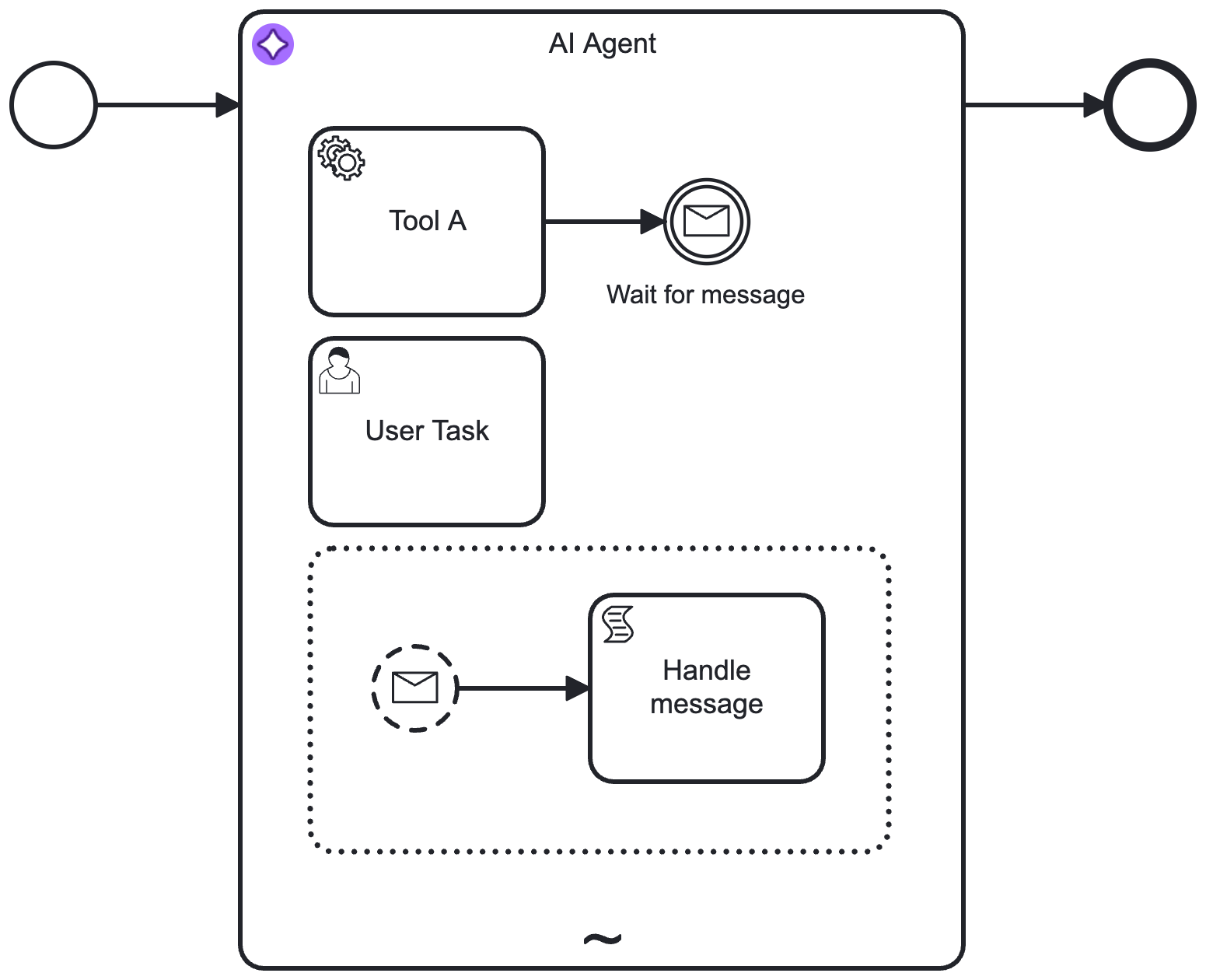
Implement an AI agent using an ad-hoc sub-process with an applied AI Agent connector template.
About this implementation
This connector implementation creates an implicit agent loop for tool calls and agent responses, using the job worker implementation type of an ad-hoc sub-process.
- For more information and usage examples, see AI Agent Sub-process.
- The example integration outlines how to model an agentic AI process using the AI Agent Sub-process implementation.
Configuration
Model provider
Select the LLM model Provider and Model. See model providers for supported providers and configuration details.
System prompt
The System Prompt is a crucial part of the AI Agent connector configuration, as it defines the behavior and goal of the agent and instructs the LLM on how to act.
| Field | Required | Description |
|---|---|---|
| System prompt | Yes | Specify a system prompt to define how the LLM should act.
|
User Prompt
The User Prompt contains the actual request to the LLM model.
| Field | Required | Description |
|---|---|---|
| User prompt | Yes | This could either contain the initial request or a follow-up request as part of a response follow-up.
|
| Documents | No | Add a list of document references to allow an AI agent to interact with documents and images. The list is internally resolved and passed to the LLM as content blocks if the document type is supported. See document support for supported file types and details. |
Memory
Configure the agent’s short-term conversational memory using the following parameters:
| Field | Required | Description |
|---|---|---|
| Agent context | No | Because the process implementation keeps the agent context within the subprocess scope, you only need to configure the agent context when the agent should resume an existing conversation, for example, to model a human-in-the-loop (HITL) follow-up like the one used in Build your first AI agent. Use this field in combination with the Include agent context setting in the response section, and ensure that it aligns with the configured result variable. Examples: |
| Context window size | No | Specify the maximum number of messages to pass to the LLM on every call. Defaults to 20 if not configured.
|
| Memory storage type | Yes | Specify how the conversation memory should be stored. See Choose a memory storage backend below for the available options and their trade-offs. |
Choose a memory storage backend
These are the available storage backend options:
- In-process storage is the default option and stores conversation messages as part of the agent context process variable, subject to variable size limitations.
- Camunda document storage stores conversation messages as a JSON document in document storage. This avoids the process variable size limitation, but you must configure a time-to-live (TTL) that matches your process's expected lifetime to avoid losing history.
- AWS AgentCore Memory stores conversation messages as events in Amazon Bedrock AgentCore Memory, an AWS-managed memory service with built-in long-term memory extraction. This offloads storage to an AWS-managed service, but adds an external dependency and its own setup and authentication requirements.
- Custom implementation uses a custom storage implementation through a customized connector runtime, available only in Self-Managed or hybrid setups. This gives you full control over how messages are stored, at the cost of building and maintaining the implementation yourself.
Evaluate these trade-offs against your process's expected lifetime, conversation size, and external dependencies to choose the backend that fits your use case.
Operate's conversation history comes from the Agent Instance API, a separate representation from wherever the agent context itself is stored. See agent context and memory for how the two relate. The backend you choose here only changes where the messages are durably stored for the agent's own context window, and whether you can also inspect them directly, for example as a raw process variable.
In-process storage
Messages passed between the AI agent and the model are stored within the agent context process variable, so you can also inspect them directly as raw JSON in the element's Variables tab in Operate.
This is suitable for many use cases, but you must be aware of the variable size limitations that limit the amount of data that can be stored in the process variable.
Camunda document storage
Messages passed between the AI agent and the model are not directly available as process variable but reference a JSON document stored in document storage.
As documents are subject to expiration, to avoid losing the conversation history you must be able to predict the expected lifetime of your process, so you can correctly configure the document time-to-live (TTL).
| Field | Required | Description |
|---|---|---|
| Document TTL | No | Time-to-live (TTL) for documents containing the conversation history. Use this field to set a custom TTL matching your expected process lifetime. The default cluster TTL is used if this value is not configured. |
| Custom document properties | No | Optional map of properties to store with the document. Use this option to reference custom metadata you might want to use when further processing conversation documents. |
AWS AgentCore Memory
Messages passed between the AI agent and the model are stored as events in Amazon Bedrock AgentCore Memory. In addition to short-term conversation replay, AgentCore Memory automatically extracts long-term memory insights from conversational messages, enabling your agent to build up knowledge across sessions.
You must create an AgentCore Memory resource in your AWS account before configuring this storage type.
| Field | Required | Description |
|---|---|---|
| Region | Yes | The AWS region where the AgentCore Memory resource is located. For example, us-east-1. |
| Endpoint | No | Custom API endpoint for VPC/PrivateLink configurations, AWS GovCloud, or other non-standard deployments. |
| Authentication | Yes | Select the authentication method for AgentCore Memory access. |
| Memory ID | Yes | The ID of the pre-provisioned AgentCore Memory resource. |
| Actor ID | Yes | Identifier of the actor associated with memory events (for example, end-user or agent/user combination). Supports FEEL expressions. |
To authenticate, choose one of the methods from the Authentication dropdown:
- Use Credentials if you have a valid pair of access and secret keys. The IAM user requires permissions for the
bedrock-agentcore:CreateEventandbedrock-agentcore:ListEventsactions.
This option is applicable for both SaaS and Self-Managed users.
- Use Default Credentials Chain if your system is configured with an implicit authentication mechanism, such as role-based authentication, credentials supplied via environment variables, or files on target host. This approach uses the Default Credential Provider Chain to resolve required credentials.
This option is applicable only for Self-Managed or hybrid distributions.
Limits
Set limits for the agent interaction to prevent unexpected behavior or unexpected cost due to infinite loops.
| Field | Required | Description |
|---|---|---|
| Maximum model calls | No | Specify the maximum number of model calls. As a safeguard, this limit defaults to a value of 10 if you do not configure this value. |
Despite these limits, you must closely monitor your LLM API usage and cost, and set appropriate limits on the provider side.
Event handling
Configures how the AI Agent sub-process should behave when handling results from an event subprocess.
In AI Agent sub-processes (implemented as ad-hoc sub-processes), only non-interrupting event subprocesses are supported.
As a result, even when using Cancel tool calls, the event subprocess itself remains non-interrupting; cancellation happens at the tool-call level, not by stopping the parent sub-process.
See How event subprocesses work with the AI Agent Sub-process for more details.
The Event handling behavior field can be set to one of these two options:
- Wait for tool call results (default).
- Cancel tool calls.
Consider the example scenario where the agent requested the execution of tools A and B, and tool B has already been completed, the following describes how each option behaves when an event is received.
Wait for tool call results
The agent waits for all tool calls (including those that create user tasks, such as “Wait for user”) to complete before handling the event.
Only after that, the job worker sends a new request to the LLM that includes one message per completed tool, each containing the corresponding event payload. For example, the timer or event subprocess handler output.
For the example scenario, the following sequence of messages would be sent to the LLM after both tools complete:
- Tool A:
Tool A result. - Tool B:
Tool B result. - Event message:
Content from event message.
Cancel tool calls
When the configured event fires while one or more tool calls are still running, the agent:
- Cancels all still-running tool calls belonging to the current agent step, including user tasks such as “Wait for user”.
- Synthesizes a message for each canceled tool and includes it in the LLM request, alongside the results of already completed tools and the event message.
- Keeps the surrounding ad-hoc sub-process scope active: the agent decides, based on the new LLM response, which elements to activate next or whether to complete the sub-process.
No BPMN interrupting event subprocess is involved; the cancellation happens purely in the agent’s control flow (job worker), not by canceling the BPMN parent scope.
For the example scenario, the following sequence of messages would be sent to the LLM:
- Tool A:
Tool A execution was cancelled. - Tool B:
Tool B result. - Event message:
Content from event message.
Event payload
To provide additional data to the LLM from a handled event, create a toolCallResult variable from the event handling flow.
The content of this variable is added to the LLM API request as a user message, after any tool call results, as follows:
- If the event subprocess creates a non-empty
toolCallResult, its contents are added as the event payload of the user message generated from the event. - If no
toolCallResultis created, a generic message is added as the user message, describing that an interrupting/not interrupting event was handled.
How event subprocesses work with the AI Agent Sub-process
In standard BPMN, an interrupting event subprocess cancels its parent scope when triggered, while a non-interrupting one runs in parallel.
For the AI Agent Sub-process (implemented as an ad-hoc sub-process):
- Only non-interrupting event subprocesses are allowed on the agent scope, by design and enforced by the modeling interface.
- The Event handling behavior field controls how the agent treats running tool calls when such a (non-interrupting) event subprocess is triggered:
- Wait for tool call results: the event handler runs only after all tool calls complete.
- Cancel tool calls: running tools are canceled, and their cancellation is surfaced to the LLM, even though the event subprocess itself remains non-interrupting from a BPMN perspective.
By modeling an ad-hoc sub-process with an AI agent, you delegate control of sub-process execution (which tasks/tools run and when it completes) to the agent.
Event subprocesses provide additional signals into that control loop, rather than performing low-level scope cancellation like a classic interrupting event subprocess.
Response
Configure the response format by specifying how the model should return its output (text or JSON) and how the connector should process and handle the returned response.
The outcome of an LLM call is stored as an assistant message designed to contain multiple content blocks.
- This message always contains a single text content block for the currently supported providers/models.
- The connector returns the first content block when handling the response, either as a text string or as a parsed JSON object.
| Field | Required | Description |
|---|---|---|
| Response format | Yes | Instructs the model which response format to return.
|
| Include assistant message | No | Returns the entire message returned by the LLM as Select this option if you need more than just the first response text. |
As the agent context is only needed outside the ad-hoc sub-process when modeling a response follow-up or external processing, there is an additional field to configure whether the context should be returned as part of the response:
| Field | Required | Description |
|---|---|---|
| Include agent context | No | Returns the agent context variable as part of the response object. Necessary when modeling a response follow-up in combination with an AI agent process as otherwise the context will only be kept in the process' internal state. Only applicable to the AI Agent Sub-process implementation. |
Text response format
If not configured otherwise, this format is used by default and returns a responseText string as part of the
connector response.
| Field | Required | Description |
|---|---|---|
| Parse text as JSON | No | If this option is selected, the connector will attempt to parse the response text as JSON and return the parsed object as
|
For an example prompt that instructs the model to return a JSON response, (see Anthropic documenation):
Output in JSON format with keys: "sentiment" (positive/negative/neutral), "key_issues" (list), and "action_items" (list of dicts with "team" and "task").
JSON response format
If the model supports it, selecting JSON as response format instructs the model to always return a JSON response. If the model does not return a valid JSON response, the connector throws an error.
To ensure the model generates data according to a specific JSON structure, you can optionally provide a JSON Schema. Alternatively, you can instruct the model to return JSON following a specific structure as shown in the text example above.
Support for JSON responses varies by provider and model:
- OpenAI: Selecting the JSON response format is equivalent to using the JSON mode. Providing a JSON Schema instructs the model to return structured outputs.
- Anthropic: JSON response format requires a JSON Schema. See Anthropic's structured outputs documentation.
- AWS Bedrock: JSON response format requires a JSON Schema. See AWS Bedrock structured output documentation.
- Other providers: Consult the provider's documentation to check if JSON response format is supported. If not, use the text response format with the Parse text as JSON option instead.
| Field | Required | Description |
|---|---|---|
| Response JSON schema | No | Describes the desired response format as JSON Schema. See OpenAI's structured outputs documentation for examples. |
| Response JSON schema name | No | Depending on the provider, the schema must be configured with a name for the schema (such as Ideally this name describes the purpose of the schema to make the model aware of the expected data. |
For example, the following shows an example JSON Schema describing the expected response format for a user profile:
={
  "type": "object",
  "properties": {
    "userId": {
      "type": "number"
    },
    "firstname": {
      "type": "string"
    },
    "lastname": {
      "type": "string"
    }
  },
  "required": [
    "userId",
    "firstname",
    "lastname"
  ]
}
Assistant message
If the Include assistant message option is selected, the response from the AI Agent connector contains a
responseMessage object that includes the assistant message, including all content blocks and metadata. For example:
{
  "responseMessage": {
    "role": "assistant",
    "content": [
      {
        "type": "text",
        "text": "Based on the result from the GetDateAndTime function, the current date and time is:\n\nJune 2, 2025, 09:15:38 AM (Central European Summer Time)."
      }
    ],
    "metadata": {
      "framework": {
        "tokenUsage": {
          "inputTokenCount": 1563,
          "outputTokenCount": 95,
          "totalTokenCount": 1658
        },
        "finishReason": "STOP"
      }
    }
  }
}
To retrieve the response text from the responseMessage object, use the following FEEL expression (assuming the response variable is named agent):
agent.responseMessage.content[type = "text"][1].text
Output mapping
Specify the process variables that you want to map and export the AI Agent connector response into.
| Field | Required | Description |
|---|---|---|
| Result variable | Yes | The result of the AI Agent connector is a context containing the following fields, depending on how the Response is configured. Set this to a unique value for every agent in your process to avoid interference between agents.
|
Error handling
If an error occurs, the AI Agent connector throws an error and includes the error response in the error variable in Operate.
| Field | Required | Description |
|---|---|---|
| Error expression | No | You can handle an AI Agent connector error using an Error Boundary Event and error expressions. |
In the error expression, you can handle the following error codes emitted by the AI Agent connector to respond to specific situations. For example, you can map a specific error code to a BPMN error and model your process accordingly.
| Error code | Description |
|---|---|
FAILED_MODEL_CALL | The call to the LLM API failed, for example, due to misconfiguration or invalid credentials. The error message contains additional details. |
MODEL_RESPONSE_CONTENT_FILTERED | The LLM provider blocked the model response with content filtering. This can happen when the provider's safety filters stop the model from returning response content. |
FAILED_TO_PARSE_RESPONSE_CONTENT | The AI Agent was configured to parse the LLM response as JSON, but parsing failed. |
MAXIMUM_NUMBER_OF_MODEL_CALLS_REACHED | The AI Agent reached the configured maximum number of model calls. |
MIGRATION_MISSING_TOOLS | Tools referenced by the AI Agent were removed after a process instance migration. Removing or renaming tools is not supported. See process instance migrations for more details. |
MIGRATION_GATEWAY_TOOL_DEFINITIONS_CHANGED | Gateway tool definitions have changed after a process instance migration. Adding or removing gateway tools to a running agent is not supported. See process instance migrations for more details. |
NO_USER_MESSAGE_CONTENT | No user message content, either from a user prompt or a document, was provided to the agent. |
TOOL_CALL_RESULTS_ON_EMPTY_CONTEXT | Tool call results were passed to the AI Agent despite an empty context, which typically indicates a misconfiguration of the agent context. |
Retries
Specify connector execution retry behavior if execution fails.
| Field | Required | Description |
|---|---|---|
| Retries | No | Specify the number of retries (times) the connector repeats execution if it fails. |
| Retry backoff | No | Specify a custom Retry backoff interval between retries instead of the default behavior of retrying immediately. |
Execution listeners
Add and manage execution listeners to allow users to react to events in the workflow execution lifecycle by executing custom logic.